

Picture this: you have just signed the paperwork to buy a boat. The lender hands you the keys; and you hand them a promise, to pay a fixed amount every single month for the next twenty years. But have you ever stopped to wonder exactly where that money goes? Why, in the beginning, does your debt barely seem to move? And why, years later, does it suddenly start shrinking faster?
The answer is amortization.
It is one of those financial words that sounds complicated but is actually very simple once you see it in action, no finance degree required, it is simply the process of paying off a loan through regular, equal payments over a fixed period of time.
Every payment you make does two jobs at once. Part of your money goes to the lender as a fee for lending you the cash; this is called interest. The other part reduces what you actually owe; this is called the principal.
Together, interest plus principal always equals your fixed monthly payment. Always. Without fail. Every single month.
Here is the part most people never get shown: how that split is actually calculated. Each month, your lender takes only your outstanding balance, multiplies it by that month’s interest rate, and that number becomes your interest charge for the month. Whatever is left of your fixed payment after that goes straight to principal. That is the entire mechanism.
No tricks, no hidden fees, just one balance, one rate, recalculated every thirty days.
This is also what makes amortization fundamentally different from a simple-interest or flat-fee loan, where interest is charged on the original amount you borrowed for the life of the loan, regardless of how much you have already paid back. With amortization, your interest bill shrinks automatically as your balance does. You are never paying interest on money you have already returned. That single design choice is what eventually turns the tables in your favour.
For example, on a R500,000 boat loan at an interest rate of 11.5% over 20 years, your monthly payment is approximately R5,332. In month one, around R4,792 of that goes to the lender as interest, and only R540 actually reduces your outstanding balance. The boat sits in its berth, entirely real, entirely yours to take out on the water, but on paper, you have barely made a dent in ownership. Why? Because interest is calculated on your outstanding balance. In month one, you owe the full amount, so the interest charge is at its highest. By month two, you owe very slightly less, so the interest charge drops by a fraction, allowing the principal portion to grow.
That slow creep is easier to see than to describe. The chart below tracks the interest portion (in red) against the principal portion (in blue) of your monthly payment across the full twenty years of this loan:
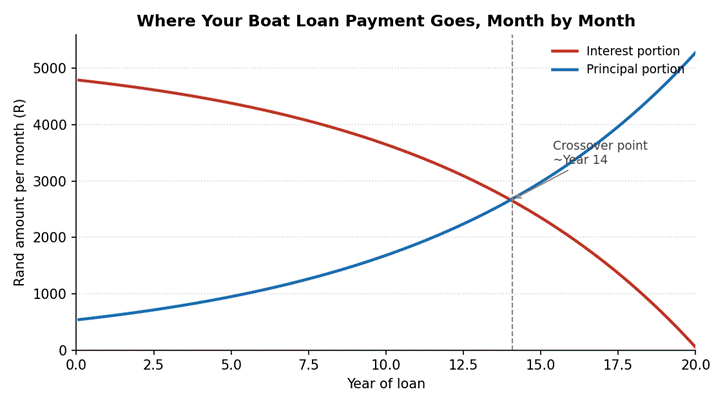
Notice the two lines crossing around year fourteen. Before that point, the red line sits above the blue one: more of your money is paying for the privilege of borrowing than is buying you equity. After the crossing, the lines swap places, and the blue line keeps climbing all the way to the top right corner, where almost the entire payment is principal. That crossing point is the moment you can actually see your loan shrinking.
Because of the high 11.5% interest rate on this specific boat loan, interest dominates the math for a long time. But around year fourteen, exactly where the chart shows the lines meet, a silent tipping point occurs. The split between interest and principal finally equalises. For the first time, you are paying more toward building real equity in your vessel than you are paying the lender for the privilege of the loan. From this point on, the snowball effect takes over, and every payment aggressively buys back your freedom.
This is why financial advisors often talk about the power of making extra payments in the early years of a loan. Every rand you pay above your minimum in those early months directly reduces your principal, which means next month’s interest charge is lower than it would otherwise have been. If you simply round up your monthly payment by R500 from day one, that small difference compounds quietly across the remaining years.
Here is why that works so well: that extra R500 goes straight to principal, with nothing skimmed off for interest, because the interest for the month was already fully covered by your normal payment. So your balance is permanently R500 lower than it would have been, which means every future month is calculated on a smaller number, forever. The saving does not happen once. It happens every single month for the rest of the loan, which is why it adds up to far more than R500 multiplied by the number of months. On this R500,000 loan, that extra R500 a month will save you over R225,000 in total interest and shave nearly five full years off your repayment period.
The final few months of the loan are almost entirely principal. Your balance is so small by this point that the interest charge on it is negligible. Your payment has not changed; it is the same number it always was, but now almost every cent of it is wiping out the final remainder of the debt.
And then comes the last payment. You make it. The maths resolves. Your outstanding balance hits exactly R0.00. The lender issues a clearance certificate. The loan is cancelled. The boat is unambiguously, entirely yours.
If you want to see this for yourself rather than take the chart at face value, ask your lender for the full amortization schedule on your own loan. This is simply a table showing every payment from month one to the very last, with each row breaking down how much was interest, how much was principal, and what your balance stood at afterwards. Run your finger down the first few rows and you will see the same pattern as the chart above: the interest column dwarfing the principal column for longer than feels comfortable. Then run your finger down the last few rows, where that relationship has completely reversed. The schedule is not just paperwork; it is the proof, month by month, that your balance will reach exactly zero on a specific, knowable date.
Understanding amortization is only useful if it changes your behaviour. Look at where you currently sit, how much of your last payment went to interest, and how much reduced your balance. Then ask yourself one question: can I add anything extra to next month’s payment, even R500? Because now you know exactly what that extra rand does. It does not vanish. It chips away a little more of your debt, lowers next month’s interest charge by a fraction, and moves your zero date closer. That is not abstract. That is money working for you, one payment at a time.