

The December-January Cash Flow Gap
Every year the festive season arrives on schedule, and every year South African businesses are caught off guard by what it does to their bank balance. Customers go quiet and invoices sit unpaid, while salaries, bonuses, rent and supplier accounts keep falling due.
Late payment makes it worse. Xero’s State of Late Payments survey of more than 500 South African SMEs found that 91% were affected by late-paid invoices, that the average overdue invoice was paid about 18 days late, and that roughly one in five struggled to pay their own staff as a result. The good news is that it is still October. Businesses that act now walk into February with their stability and reputation intact.
Why December and January Hurt
Revenue doesn’t just decline during the festive season. Customers may pay later than usual, while expenses still need to be paid on time.
Money Going Out (and not slowing down):
- Salaries, 13th cheques and bonuses, often paid early in December and landing in the slowest month.
- Stock bought ahead for the peak, and again in January, before last season’s cash arrives.
- Fixed overheads: rent, insurance, vehicle finance, subscriptions, utilities and loan repayments all fall due as per normal course of business.
- Tax: PAYE and VAT deadlines don’t move, and the 2nd provisional tax payment is due at the end of February. Check the SARS calendar.
- January resets: supplier price increases, licence renewals and insurance premiums.
Money Coming In (and slowing down):
- Customers who close for two or three weeks stop ordering.
- Delayed payments: an invoice raised in late November on 30-day terms, paid the typical 18 days late, falls due in mid-January, before any holiday delays. It may not be settled until late January or February.
- A slow restart: January is often spending without earning.
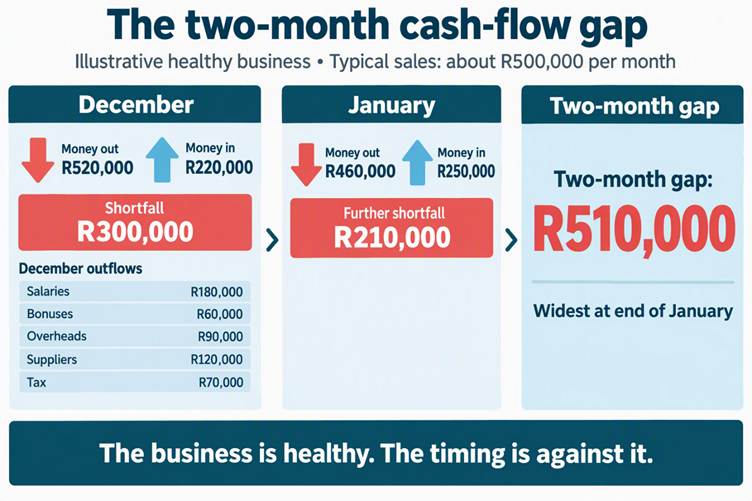
A business can be profitable on paper and still run out of cash. Profit is not cash flow, and cash pays the bills.
The Gap in Rands
Take a hypothetical healthy business with sales of about R500,000 a month (illustration only). In December it pays out R520,000 (R180,000 salaries, R60,000 bonuses, R90,000 overheads, R120,000 suppliers, R70,000 tax) and receives R220,000, a R300,000 shortfall. In January it pays out R460,000 and receives R250,000, a further R210,000 shortfall. The two-month gap is R510,000, at its widest at the end of January. Nothing is wrong with the business. The timing is against it.[MT1]
Why Owners Don’t Prepare
The busy season masks the risk, cash is already reinvested, margins are thin, owners are optimistic that late payments will arrive, and forecasting loses out to serving customers. None of this is a failing. It simply means preparation has to be deliberate.
Close the gap before you borrow
Every rand you close yourself is a rand you don’t borrow.
- Forecast week by week to the end of February, listing known payments and realistic receipts. The gap is your target.
- Invoice early, confirm payment dates before customers’ accounts departments close, and chase overdue invoices.
- Offer early-payment discounts, which can be cheaper than funding the delay.
- Ask suppliers for extended or staggered terms, in October rather than January.
- Discuss bonus timing where contracts allow, and take advice first.
- Clear slow-moving stock and defer non-essential purchases and renewals.
It Isn’t Only the Festive Season
The same “pay before you earn” pattern hits back-to-school trade (January and February), winter and summer businesses, harvest and planting cycles, holiday clusters, and event peaks such as Easter, Black Friday and Mother’s Day. The longer the gap, the more working capital you need.
Where Bridging Finance Fits in
Bridging finance is short-term funding that carries a business across a temporary gap between money going out and money coming in. It is not about funding a struggling business. It matches the timing of your cash to the timing of your costs. It is one tool among several, alongside overdrafts, invoice discounting, supplier credit and stock finance.
It Can Make Sense When:
- the gap is clear and known, with a clear source of repayment such as outstanding invoices or returning trade;
- you need to pay staff and suppliers on time, or buy stock at the right moment;
- the total cost is clearly lower than the alternative, such as penalties, lost goodwill or missed orders.
Be cautious when the shortfall points to a deeper margin, pricing or cost problem, there is no realistic repayment plan, or repayments start while you are still in the slow period.
Don’t leave it until December
Lenders, accountants and banks slow down in December, and assessments take longer. Starting in October or early November gives you time to prepare documents, compare offers and choose suitable terms. Work backwards from your first big payment, usually the December payroll and bonuses, and apply well before it.
- Have you mapped cash flow week by week to the end of February?
- Do you know the date and size of your biggest outflows?
- Have you confirmed payment dates on outstanding invoices, spoken to key suppliers and decided how bonuses will be paid?
- Do you have a reserve or funding lined up for the gap?
- Have you gathered recent bank statements, financials and a list of outstanding invoices?
If not, you are not behind.
You’re just in time.